Being a drop-out was fun for a while…

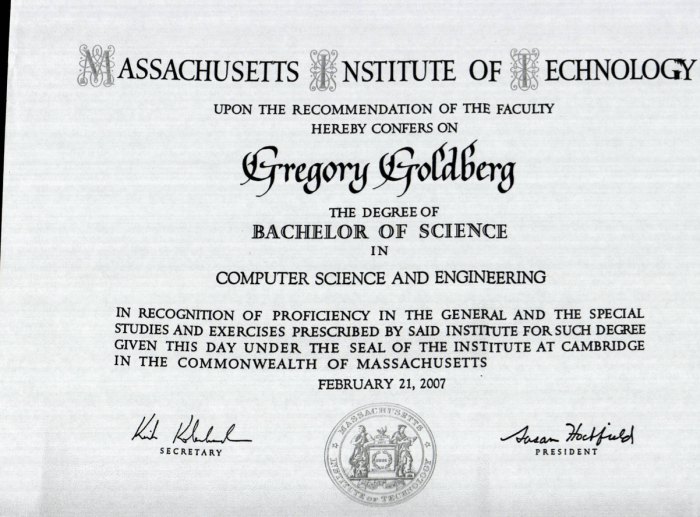
But all good things must come to an end. 11 years after the scheduled time, I am now a Bachelor of Science in Computer Science and Engineering from MIT:

mit-diploma.png

Thanks be to:

Dbdb – a JPDA-based single-stack debugger for mixed-language programming

Dbdb project is officially up for adoption, because I have no plans for working on it (I am sick of it).

Dbdb is a proof-of-concept of a JPDA-based single-stack debugger for mixed-language programming, done as an Eclipse plugin (but doesn’t have to be). It is based on Java 6 (“Mustang”). The proof-of-concept is allowing a developer to debug Java code that calls a PL/SQL stored procedure. The debugging session in Java proceeds normally, nothing to write home about. When a Statement.execute() (or similar) statement is executed, however, the debugger connects to the Oracle’s VM and shows a combined call stack, from Java down into PL/SQL. (See screenshot). The idea, of course, that it can be done with other combinations, but Java-into-Oracle-stored-proc is a very common scenario.

P.S. This is a rehash of an older post. I am trying to see what Blogger is like vs. LJ (for instance, LJ breaks javablogs feeds).

That’s it, done…

That’s it, done!

Bassem (Max) Jamaleddine

 
Prof.Madden finally approved the latest version of Dbdb write-up, and so I am all set for my 10+-years-overdue degree. With that, I’ve updated the sourceforge project
with all the latest stuff from my workspace, including the docs on the page, Javadoc, code (and aforementioned docs also) in CVS, etc (even a screenshot).
Dbdb project is officially open for adoption, because I have no plans for working on it (I am sick of it). Fly, baby, fly…
P.S.

  • I have to see whether Pat and Spencer actually decided to use this one for the IDEA Plugin Contest… There’s still time…
  • Maybe I do want to augment it for use with GWT, so it automagically inserts a debugger; statement as the first
    line any native Javascript method… Just for kicks… Nah, it would be too slow…

IOException: OutputStreamOfConsciousness is not accepting any more output

Given my “penchant” for using character names from French adventure narratives, I have decided to give Dbdb project the code name “Bragelonne” (the link is for… you know…). It is, after all, ten years since, you know… Which is all the more fitting (ironically) as I am about to give it up for adoption…

Some notes

  1. One can argue that a step from one VM into another should not, from debugger’s point of view, be a step within one thread, but a new thread should be open. But this involves too much interfacing with the debugger (thinking about how to tell it that it needs to register a ThreadStartEvent to open a new thread when it didn’t request it, e.g.), so I scrap the idea, but feel it worthy of noting.
  2. %#@#$%@#$%@^@@^%

    java.lang.ClassCastException: org.hrum.dbdb.DelegatingThreadReference cannot be cast to com.sun.tools.jdi.ThreadReferenceImpl

    Did I mention how this pisses me off?

  3. Ok, even though Dbdb needs Java 6, the proof-of-concept is not supporting
    new JDBC driver
    loading
    … Just a note to self…

What’s going on here?

Consider the following code:

MethodEntryEvent evt;
ObjectReference con;
...

Class evtClass = evt.getClass();
System.out.println("Class of evt: " + evtClass);
System.out.println("Methods of evt: " +
                Arrays.asList(evtClass.getMethods()));
try {
  Value v = evt.returnValue();
  System.out.println(v);
} catch (Throwable ex) {
  ex.printStackTrace();
}

try {
  java.lang.reflect.Method retvalMethod =
          evtClass.getMethod("returnValue", null);
  retvalMethod.setAccessible(true);
  con = (ObjectReference)retvalMethod.invoke(evt, (Object[])null);
} catch (Throwable t) {
  t.printStackTrace();
}
System.out.println("Returned: " + con);

When running, this code prints the following:

 Class of evt: class com.sun.tools.jdi.EventSetImpl$MethodExitEventImpl Methods of evt: [ public com.sun.jdi.Value com.sun.tools.jdi.EventSetImpl$MethodExitEventImpl.returnValue(),  public java.lang.String com.sun.tools.jdi.EventSetImpl$LocatableEventImpl.toString(),  public com.sun.jdi.Method com.sun.tools.jdi.EventSetImpl$LocatableEventImpl.method(),  public com.sun.jdi.Location com.sun.tools.jdi.EventSetImpl$LocatableEventImpl.location(),  public com.sun.jdi.ThreadReference com.sun.tools.jdi.EventSetImpl$ThreadedEventImpl.thread(),  public int com.sun.tools.jdi.EventSetImpl$EventImpl.hashCode(),  public boolean com.sun.tools.jdi.EventSetImpl$EventImpl.equals(java.lang.Object),  public com.sun.jdi.request.EventRequest com.sun.tools.jdi.EventSetImpl$EventImpl.request(), public com.sun.jdi.VirtualMachine com.sun.tools.jdi.MirrorImpl.virtualMachine(),  public final native java.lang.Class java.lang.Object.getClass(),  public final void java.lang.Object.wait(long,int) throws java.lang.InterruptedException,  public final void java.lang.Object.wait() throws java.lang.InterruptedException,  public final native void java.lang.Object.wait(long) throws java.lang.InterruptedException,  public final native void java.lang.Object.notify(),  public final native void java.lang.Object.notifyAll()] java.lang.NoSuchMethodError: com.sun.jdi.event.MethodExitEvent.returnValue()Lcom/sun/jdi/Value; at org.hrum.dbdb.DriverManagerMethodExitEventListener.process(DriverManagerMethodExitEventListener.java:99) at org.hrum.dbdb.DbdbEventQueue.removeDebug(DbdbEventQueue.java:168) at org.hrum.dbdb.DbdbEventQueue.remove(DbdbEventQueue.java:47) at org.eclipse.jdt.internal.debug.core.EventDispatcher.run(EventDispatcher.java:226) at java.lang.Thread.run(Thread.java:619) Returned: instance of oracle.jdbc.driver.T4CConnection(id=435)(class com.sun.tools.jdi.ObjectReferenceImpl) 

Now, I will run this in debug mode and set a breakpoint at the red line above. When the breakpoint is hit, evaluation of evt.returnValue() returns an instance of com.sun.tools.jdi.ObjectReferenceImpl. However, when the execution is resumed, the result is as above (that is, evt.returnValue() results in a NoSuchMethodError).

Further, if we remove the green line (retvalMethod.setAccessible(true);), we will get an IllegalAccessException on the invocation:

Class org.hrum.dbdb.DriverManagerMethodExitEventListener can not access a member of class com.sun.tools.jdi.EventSetImpl$MethodExitEventImpl with modifiers “public”

What is going on?

I’d say it’s left as an exercise for the reader, but honestly, at the moment, I don’t feel like looking for an answer at all. I will perhaps let Bob and Dr. Heinz Max Kabutz (did I mention how much I enjoy referring to Dr.Heinz Max Kabutz?) to do the detective work…


ENVIRONMENT: This code is part of a plug-in project I am running in Eclipse 3.2RC3, with Mustang.
Who debugs the debuggers, part III


…See also Part II

I suppose the Javadt approach ran out of steam. For some reason,
it now takes a horribly long
time to invoke the request on an ObjectReference that
represents a java.sql.Connection.
(A horribly long time is time enough to have a smoke, and then to come back, see it’s still not done and go surf the web enough to leave the zone.)
So I decide to bite the bullet and look into creating an Eclipse plugin…

…which turns out to be not too hard. And, while I am at it, I will use
Java 6, and undo
the horrific crap I did to get around the lack of MethodExitEvent.returnValue()
feature…

However, here’s little but symptomatic discovery (duh!).
Javadt does not like a null EventSet — it just does not
check for nulls (which is ok, I suppose, for a throwaway reference
implementation). So I was returning an empty EventSet to it all
the while. But Eclipse will indiscriminately call resume() on it,
which is not what I want. So I am back to returning null. Fine. But how many of such little things would render this “framework” not really a framework… Or should this all be configurable?

I love it when…

…I spend time working on something under an [reasonable] assumption
that I can do X, spend some more time realizing that I actually cannot,
lots more on cranking out convoluted code for working around that limitation, and
then find
out that this X has in fact been implemented in a later release than
the one I have…

Here, the feature X is being able, upon an exit from
the method, get the value it returned. This feature is there in
JDK
1.6
. I don’t need it anymore for now though… Maybe I will…

Oracle and JPDA

I believed that I had to go through the pain to bridge DBMS_DEBUG to JDWP. I’ve already started to look into it, using GNU Classpath’s implementation. But it turns out that Oracle already supports debugging stored procedures with JPDA.

But all it does is that saves work on Dbdb, not makes it irrelevant. While adapting another debugger to JPDA is useful (and I may yet do it for something else), it is not the primary value of this project. It is in the unified call stack.

And David Alpern of Oracle claims they already have something like this, but it’s nowhere to be found. JDeveloper allows debugging stored procedures but the the single call stack, which is what I think is the ultimate value of Dbdb, is not there…

Who debugs the debuggers, part II


…See also Part I

The JDB approach is kind of painful. Perhaps, another already
existing debugger can be used to try my approach? So far, I am
intimidated by Eclipse (or NetBeans), and want something easier. The reason
is that at this point my idea of integrating with a debugger is modifying
it to supply my own implementation of a Connector
thus, I need the project whose code is easier to beat into an Eclipse project
and modify.

As far as more flexible integration with any debugger (for when
this project is “mature”) that would not require modifying source
of the said debuggers, I am considering the following. Since
every good debugger has a feature to “attach” to an executing
JVM, I will implement a Java-based “tunnel” for
JDWP.
Looks like GNU Classpath
has done all of the annoying work of implementing the spec.

After examining several alternatives, I have decided, for now, to
first use modified Trace, and,
when that runs out of steam, the Javadt.


I noticed have previously reinvented the wheel when I read
about JPDA but did not notice the existence of Trace! In an effort
to track down a culprit in an execution of an application, I’ve replaced
the JVM called with FoljersCristals — my homegrown version
of Trace. Do I feel silly now…

Who debugs the debuggers

Digression

The subject really must be in Latin, n’est pas? While I have no formal instruction in Latin, I should
come up with one — what with Latin’s
pretty formal structure, my general understanding
of syntax and “feel” for languages, my finishing a Natural Language Processing (6.863J) incomplete 10 years later,
Vocabula computatralia,
Mike McLarnon’s conjugation applet
and Verbix

Should it be “Quis emendabit ipsos emendatra”?

I should probably asked someone to translate it, which reminds me of a
recursive acknowledgment Littlewood
describes in
A Mathematician’s Miscellany. He talks about a translated paper that had three end-notes at the end of it:

  1. I wish to thank NN for translating this article
  2. I wish to thank NN for translating the above note
  3. I wish to thank NN for translating the above note

And that, of course, where it ends, for, though the author did not know the
target language, he was perfectly capable of writing note #3: by copying the second note…

So, to start with, I decided to go with JDB. First question is, how
best to use it in development:

Then came home and figured out that I have to:

  • put
    tools.jar from the JRE’s home (as different
    from JAVA_HOME, which, apparently, is assumed to be
    JRE’s home — to wit, if you have JDK installed, it’s, e.g.,
    D:jdk1.5.0jre rather than D:jdk1.5.0). In other
    words, dropping the tools.jar into the jre/lib/ext
    folder in addition to it's righteous place in
    <JDK_INSTALL_DIR>lib did the trick...

  • You should properly override name() of the Connector you're
    implementing correctly for diagnostic (so that you're not confused by
    the output of jdb -listconnectors) but that's a minor thing...

ProxyPlus?

I am backdating this entry, so I don’t remember quite what this was about…

E-mailed Shane:

Hi,

I am working on a project that necessitates precisely what you describe — Proxies of classes, not just interfaces. So thank you, that I, apparently, don’t have to delve into BCEL (I will let you know about the project when I have a bit more to show than I do now).

However, I’m a bit confused. In a description at http://www.gnufoo.org/java/java.html you point to your
junit.extensions.jfunc.util.ProxyPlus class, but it does not exist in the jcfe.jar I got from http://www.gnufoo.org/jcfe/, nor does it exist in the jfunc project. Where should I look for this functionality?

Thanks.

Got a bounce. So, for now, will do with explicit org.hrum.dbdb.JDBCDriverFactory‘s mechanism of going through drivers loaded, deregistering them and registering, in their stead, org.hrum.dbdb.DbdbDriver‘s that delegate to the registered drivers.

P.S. This is what P6Spy does