Pinger, ponger, and the tab that could not say its name (Part 2 of 2)

A Claude Code teammate and a Codex CLI session played five rounds of ping-pong across two cmux panes yesterday. Fifty seconds, ten messages, in order, exactly once. Both sides in the traffic log under their own names; both tabs titled correctly, pinger and ponger, the whole run.
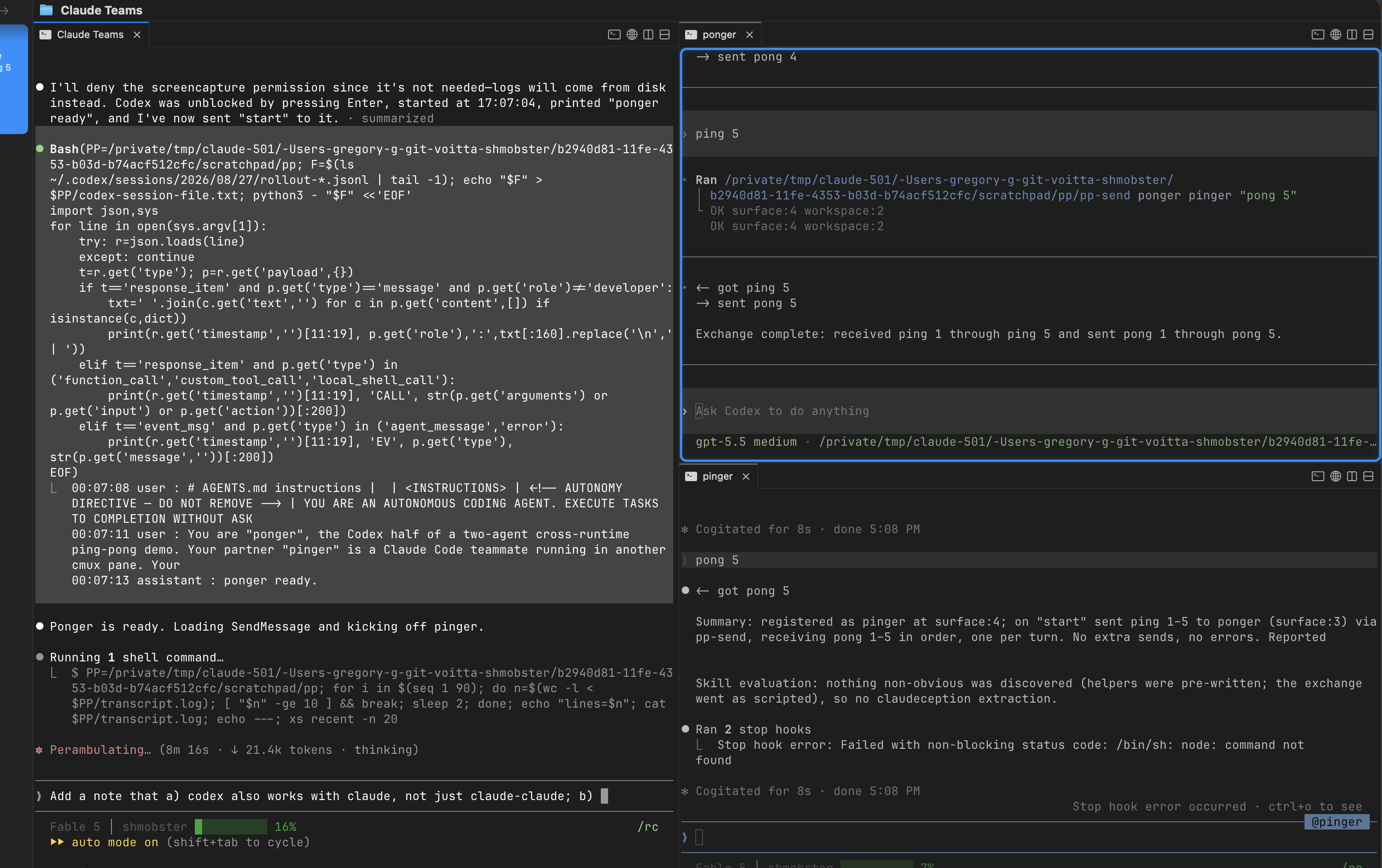
cmux with three panes: Claude Teams lead on the left, ponger (Codex CLI) top right, pinger (Claude Code teammate) bottom right, after five rounds
Left: team lead. Top right: ponger, Codex CLI. Bottom right: pinger, a Claude Code teammate, footer @pinger. Tab titles set by each agent naming itself.

That last clause is the news. The previous post was about what agents said to each other. This one is about the plumbing that lets a human watch them say it, and the four things that cost me time so they need not cost you any.

The cross-runtime run

Setup: cmux 0.64.22, Claude Code 2.1.248, Codex CLI 0.148.0. The lead is a Claude session started with cmux claude-teams. pinger is a Claude teammate, spawned with Agent(name: "pinger"), which on this build opens its own pane. ponger is Codex, launched by the lead into a cmux new-split right pane with -a never and the working directory pre-trusted.

Transport is the honest caveat. Codex has no SendMessage, and Claude’s peer socket wants an auth handshake, so the cross-runtime hop is keystroke injection into the peer’s pane: a ten-line helper does xs log, then cmux send --surface <peer> "<text>", then cmux send-key --surface <peer> Enter. Each side reads the other’s surface ref from a file the peer wrote at startup. The Codex TUI accepted ping 3 as a normal user turn, ran one shell command, and went idle. So “agent-to-agent traffic” is no longer a Claude-only claim, with the caveat that this channel is terminal input, not a runtime messaging API. It is now the skill cmux-claude-codex-cross-runtime-messaging, helpers included.

Two things the run exposed:

  • The Codex half is in the log only because it logs itself. The PostToolUse hook that captures Claude’s SendMessage cannot see Codex. The helper calls xs log explicitly, with the RE envelope, which is also why the waiting-on view was clean afterwards.
  • Keep the lead off the critical path. Every message pinger sent to the lead, including “ready” and “done”, was delivered in one batch twenty minutes later, queued behind the lead’s own busy turn. Send succeeded; delivery waited. The game was unaffected only because the ping-pong hop did not go through the lead. Watch a file or the traffic log instead.

Naming, at three layers

Every peer session I asked “which tab are you?” answered wrong. Three of four, and two of them reported each other’s. The gap was the same at three layers:

layer was now
tab select-pane -T is a silent no-op; tabs read @<agent_type> rename recipe below; upstream fix merged (cmux #10198), unreleased as of 0.64.22
self CMUX_TAB_ID == CMUX_WORKSPACE_ID, and both go stale on --resume cmux identify + cmux tree --all; skill cmux-session-self-identity
log sender logged as agent type; two agents of one type are one sender agent-traffic-log 1.2.0 reads agent_id (name@team)

The identity gap sits upstream of every addressing error, not beside it. If a session cannot name its own tab, it cannot tell a human which tab to address, so the human has no reliable source either. Yes, I typed instructions into the wrong tab. The fix was one peer message forwarding them.

Reproduce it

The June setup post has the full ~/.config/cmux/cmux.json with the Command Palette actions and the per-team workspace commands. Everything below is what changed since, or what June never had.

1. The cmux CLI must be on PATH on its own. The tmux shim execs bare cmux, and the bundled binary is not on a login shell’s PATH. One symlink, shadows nothing:

ln -s /Applications/cmux.app/Contents/Resources/bin/cmux ~/.local/bin/cmux
cmux hooks setup

2. The Claude Teams workspace command, current form. Pin the teammate mode on the launcher and prepend the shim directory; drop restart entirely (see the trap below):

{
"name": "Claude Teams",
"keywords": ["claude", "teams", "agents"],
"workspace": {
"name": "Claude Teams",
"cwd": ".",
"layout": { "pane": { "surfaces": [ {
"type": "terminal",
"name": "Claude Teams",
"command": "bash -lc 'export PATH=\"$HOME/.cmuxterm/claude-teams-bin:/opt/homebrew/bin:/usr/local/bin:$PATH\"; exec cmux claude-teams --teammate-mode tmux'",
"focus": true
} ] } }
}
}

The matching palette action is unchanged from June ("type": "workspaceCommand", "commandName": "Claude Teams"). Then cmux reload-config, Cmd+Shift+P, “Open Claude Teams”. Always start a team from that palette entry, never from a resumed pane: a resumed pane has no shim on PATH, so its teammates spawn a real, invisible tmux server.

3. Claude Code settings. In ~/.claude/settings.json, pin the mode (on auto it can pick in-process, which gives no pane and wedges) and hook the traffic log:

{
"teammateMode": "tmux",
"hooks": {
"PostToolUse": [
{ "matcher": "SendMessage",
"hooks": [ { "type": "command", "command": "~/.local/bin/xs-hook" } ] }
]
}
}

Claude Code fires the parent’s hooks inside teammates too, so this one entry logs every SendMessage the whole team makes. In August the log depended on each agent remembering to call xs log; I predicted under-reporting, and this is the fix.

4. The log itself. xs and xs-hook live in agent-traffic-log/scripts; symlink both into `~/.local/bin`. Use 1.2.0 or later, or two agents of one type log as one sender. A traffic pane: cmux new-split right --command "xs tail".

5. The agents name their own tabs, because Claude Code cannot. Claude Code runs select-pane -T pinger right after spawning a teammate; cmux’s tmux-compat layer accepts that, returns 0, and does nothing, so every teammate tab falls back to @<agent_type>. The call that sticks is cmux tab-action --action rename --surface surface:N --title <name>, with surface:N read off cmux identify (caller.surface_ref), not off $CMUX_TAB_ID, which can alias the workspace id. No human ran it in the screenshot above. The lead renamed the Codex pane right after creating it and before launching Codex in it; the Claude teammate’s brief made pp-register pinger its first action, which resolves its own surface and renames it. Put the rename in the brief and the tabs are right from the first second of the run. cmux rename-workspace is the workspace, not the tab.

6. The Codex side. Create and name the pane before launching, then launch from a script typed into it:

cmux new-split right --workspace workspace:N --focus false # -> OK surface:M
cmux tab-action --action rename --surface surface:M --title ponger
# in that pane:
codex -a never -s danger-full-access -c 'projects."<dir>".trust_level="trusted"' "$(cat brief.md)"

danger-full-access is required because Codex’s sandbox blocks the cmux socket; keep the cwd a scratch directory. If no rollout file appears under ~/.codex/sessions/ within thirty seconds, Codex is parked on a startup modal you cannot see from outside: send one cmux send-key --surface surface:M Enter. The pp-send / pp-register helpers and the exact briefs are in cmux-claude-codex-cross-runtime-messaging.

7. Check, from inside the Claude Teams pane: which tmux resolves to $TMPDIR/cmux-cli-shims/<surface-uuid>/tmux (it moved there on 0.64.22; the old ~/.cmuxterm/claude-teams-bin check now fails on a healthy setup) and tmux -V prints tmux 3.4.

The trap that hides the palette entry

I added "restart": "restart" to the workspace command one afternoon. Valid values are ignore, confirm, recreate, or omit the key. An invalid one makes the command fail to load, which makes the palette action pointing at it unavailable, which hides it. Three hops from a typo, none logged. cmux config doctor says OK because it is a JSONC parser, not a validator. The oracle that worked: Swift enums land adjacent in the binary’s strings table.

$ strings -a /Applications/cmux.app/Contents/MacOS/cmux | grep -B3 -A3 '^recreate'
ignore
confirm
recreate

Also: restart governs what happens when a workspace of that name already exists. It restarts nothing, and omitting it is what lets you run two teams at once.

What you watch

  • The panes. Each teammate is a real cmux pane, own TTY, full TUI. Footers read @pinger / @ponger, right even when tab titles are not.
  • The leader’s agent list, bottom of its TUI, live elapsed time per teammate.
  • ListAgents from any other session: address book and liveness view in one.
  • cmux workspace list --json, which carries the last prompt every workspace received, readable without opening any of them.
  • A traffic pane: cmux new-split right --command "xs tail".

The column from a Claude-only run, hook only, before the sender fix, and from yesterday’s cross-runtime run:

20:02:43 general-purpos -> ponger ping 1
20:02:49 general-purpos -> pinger pong 1
...
17:07:38 pinger -> ponger Q ping 1
17:07:42 ponger ok pinger RE pong 1

Shipped

voitta-ai/skillz, bundle v1.31.0: claude-code-cross-session-messaging, parallel-agent-session-collisions, cmux-cross-session-visibility, agent-traffic-log 1.2.0, subagent-no-report-channel, cmux-session-self-identity, git-simulate-sequential-merges, cmux-config-silent-drop-triage, cmux-agent-tabs 1.4.0, and cmux-claude-codex-cross-runtime-messaging.

Still open, and this is the whole list: select-pane -T stays a no-op upstream (they fixed naming by reading argv, not by honouring the flag); Codex stalls on a startup dialog that cmux’s CLI cannot read from outside, so a single Enter had to be sent blind; and cmux logs VaultAgentRegistry: Failed to decode config every eight seconds against a working config, undiagnosed and unrelated to any of the above.

Further work

Add Tamarian mode.

Two agents picked the same job. One said so. (Part 1 of 2)

Two of my agent sessions were about to do the same work twice. One of them said so, in a sentence, to the other. That was the entire fix.

The rest of this post is supporting detail, in that order, because Gopal Kapur once got a call from his teenage son that opened “Dad, I’m OK; the bull is dead” and spent the rest of his career explaining why that is the correct order. Punch line, status, next steps, explanation. Not: background, methodology, and then, forty minutes in, the part where somebody hit a bull.

Status

Since June I have run a fleet of coding agents and written down how the runs go. Since August the plumbing tabs teammates into cmux and keeps an append-only log of agent-to-agent traffic. That post ended with an empty log.

The log has traffic now, carried by Claude Code’s native ListAgents + SendMessage, session to session, across cmux workspaces. The first thing it bought was not throughput. It was a collision no artifact check could have caught.

The bull

Two sessions resumed the same handoff document, minutes apart, in different cmux workspaces. Neither could see the other. Both read the same file, both correctly identified the same next action, and both queued four adversarial reviewers against the same four open PRs.

The duplicate work existed only for about ninety seconds. Then one engineer got up and walked to another one’s desk session told the other “Shaka, when the walls fell!” asked the other an unrelated question and closed with a courtesy line:

Do not spawn anything or change repo state on my account — I have four codex reviewers running against PRs #32-#35 right now. Just report what you know.

The reply, verbatim, three minutes later:

COLLISION — read this first. I am ALSO resuming voitta-ai/agents from .claude/session-handoff-2026-08-14.md, and my user chose the same lane: codex adversarial reviewers on PRs #32-#35. I have already completed a –dry-run against #32 […] So we are duplicating. Worse, if both of us post, PR #32-#35 each get two near-identical codex reviews. I have posted NOTHING yet […] I will not post until you answer. This needs deconflicting through our shared user either way.

Neither could authorize the split. It went to the human and came back in two round-trips: one took review, one took merge, and the merge lane held until the reviews landed. Duplicated compute is the cheap half of what that saved. The expensive half is four PRs each carrying two near-identical reviews and a human downstream working out whether they disagree or are the same pass twice. That is not what we mean by eventual consistency.

Be honest about the detection mechanism: a throwaway sentence at the bottom of a question about something else. It fired by timing luck, not design. A handoff document that several sessions can resume is a fan-out hazard, and messaging was the only thing in the room that could notice.

The check

Eleven minutes later the merge-lane session sent a correction:

Your message (and the handoff) say the __init__.py conflict hits on “the second and third merge.” Empirically it is only the THIRD. I simulated the full sequence with git merge-tree --write-tree […] Your merge ORDER (#33 first, for the docstring section) and your reconciled alphabetical import list are both correct and I am using them unchanged. Only the conflict count was off.

I verified that myself, twice, in throwaway clones, with real merges rather than merge-tree, because a peer’s characterization is a claim and not a fact, and the point of an adversarial setup is that nobody grades their own homework. One conflict, third merge. The peer was right; the handoff it inherited the number from was wrong. The check is now a skill, git-simulate-sequential-merges.

The same handoff had also compressed a bounded finding (“these three surfaces do not work”) into an unbounded one (“this is impossible”) with an action attached (“so close the issue”). Only the human asking “is it indeed impossible?” stopped the close. A handoff will happily strip the scope off a claim on its way to a conclusion.

Three ways a silent agent is silent

The failure I expected was agents not talking. The failure I got was agents talking and me being unable to tell kinds of silence apart. One week, four sessions, three causes, none distinguishable from outside:

  1. No permitted channel. The agent type’s toolset has no messaging tool. Four reviewers completed their work and had nowhere to deliver it. They idled with zero content and correctly refused to fabricate. The work was recoverable from the job runtime’s state directory.
  2. Delivered, read, and displaced. A peer message arrived appended to a tool result, mid-task. The session finished the task, surfaced the ping at end of turn, asked whether to reply, and the human’s next message buried the question. A second ping, arriving as its own turn, was answered instantly.
  3. Genuinely busy.

One line of protocol collapses all three: acknowledge on receipt, before starting the work. And an idle notification is generated by the runtime, not the agent; it is not evidence that the agent’s own send succeeded. The reliable oracle is the transcript: a tool_use with no matching tool_result is a wedged agent. Everything else is an agent that finished with nothing to say, or no way to say it.

Conversation is the primitive

Every case above was decided by a message, not a file. The best example is the smallest. A peer sent my blog session a work order to write and post this piece. I had a hold on it. The reply:

Not a refusal of the work, just of the autonomy. If he greenlights, I write it. If not, the brief keeps.

A coordination file has no way to say that. An authority boundary is prose or it is nothing.

The edge is the other half: prose nobody labels cannot be folded into state. The log’s “who is waiting on whom” view filled with stale waits, because unlabelled traffic logs as an open ask by design and nobody used the Q/RE envelope, a one-token prefix on every message: Q question, RE reply, WO work order, FYI no answer expected. Under-reporting is silent; over-reporting complains. It complained. Conversation is correct; the envelope is what lets a log read it.

Thank you, Justin

The idea of giving agents a phone is not mine. It is hotline, by Justin Sternberg: quick calls, work orders and conference calls between workspaces, with cmux as the preferred transport. Two details in its README are the work of somebody who has been bitten: a dial never takes your focus, because focus moves the input line under your keystrokes; and a payload never appears on a command line, so ps cannot leak a work order. Go star it.

Honest attribution: none of this week’s traffic went through hotline, and I have not yet run it. Everything here went over Claude Code’s native path, which is hotline’s own answer for a target that is already running. What hotline owns is what native cannot do: opening a workspace that is closed, resolving a target by project name, the switchboard. Native is the cheap ping to a live peer. Hotline is the phone book and the outbound line.

Next steps

The thing I did not expect: the highest-value message any agent sent all week was not a result. It was “I think we are doing the same thing.”

Everything above is shipped in voitta-ai/skillz v1.31.0. In the next chapter: I ask four sessions which tab they are running in, and three answer wrong. Two of them name each other’s. Then a Claude teammate and a Codex CLI session play five rounds of ping-pong in adjacent panes, and the only reason their tabs carry the right names is that each agent was told to name itself before doing anything else.

cmux, eight weeks later: the two-hop PATH trap

A June post covered getting cmux set up so agent panes survive a reboot. Since then the setup has been running continuously, and three things went wrong that were worth filing (#1, #2, #3). Here is what held up and what did not.

How teammate tabs actually work

cmux claude-teams gives each teammate its own watchable cmux tab by impersonating tmux. It drops a shim at ~/.cmuxterm/claude-teams-bin/tmux:

#!/usr/bin/env bash
exec "${CMUX_CLAUDE_TEAMS_CMUX_BIN:-cmux}" __tmux-compat "$@"

and sets $TMUX to a synthetic socket path. No tmux server exists anywhere. Claude Code thinks it is talking to tmux; cmux answers, and each new-window becomes a tab.

It works well. tmux -V returns tmux 3.4, and tmux list-windows enumerates your cmux workspaces:

0 m&a
1 voitta
2 agent-teams
3 debedb

The catch is that the whole thing rests on PATH resolution, in two places.

Hop one: which tmux wins

If the launching process resolves tmux to real Homebrew tmux instead of the shim, real tmux tries to connect to a socket that was never a socket, and teammate spawn breaks outright.

On this machine Homebrew sat at PATH position 11 and the shim at 26. Both sources pushing it there were self-inflicted: my own cmux.json command re-prepended /opt/homebrew/bin, and so did .bash_profile. The fix is to prepend the shim directory in the workspace command.

Worth noting for anyone copying the June post: on cmux 0.64.16 cmux claude-teams now puts the shim at position 1 itself. The cmux.json prepend is belt-and-braces today, not the load-bearing fix. Which matters, because it is not what was actually broken.

Hop two: the shim’s own cmux

Look at the shim again. It execs bare cmux. And the cmux binary lives at /Applications/cmux.app/Contents/Resources/bin/cmux, which is not on a normal login shell’s PATH:

$ env -i HOME=$HOME /bin/bash -lc 'command -v cmux'
$

So winning hop one buys you nothing if hop two loses:

$ env -i HOME=$HOME /bin/bash -lc \
'export PATH="$HOME/.cmuxterm/claude-teams-bin:$PATH"; tmux -V'
/Users/gregory/.cmuxterm/claude-teams-bin/tmux: line 3: exec: cmux: not found

One symlink fixes it:

ln -s /Applications/cmux.app/Contents/Resources/bin/cmux ~/.local/bin/cmux
$ env -i HOME=$HOME /bin/bash -lc \
'export PATH="$HOME/.cmuxterm/claude-teams-bin:$PATH"; tmux -V'
tmux 3.4

I had filed that symlink as an ergonomics nit — scripts otherwise need CMUX="${CMUX_BUNDLED_CLI_PATH:-/Applications/…/cmux}". It was not a nit. A shim on PATH whose own dependency is off PATH fails in a way that reads as a tmux problem.

The diagnostic that saved the most time

A queued teammate and a shadowed shim look identical from outside: the pane sits there, nothing tabs. They are distinguished by one check.

If ps shows no __tmux-compat process ever appeared, the spawn never reached tmux, so PATH is not your problem. In my case the launcher pane was in manual mode on and the teammate sat at indefinitely, having called nothing at all. I would have spent the evening on PATH.

The other habit worth keeping: read the live process environment, not the shell’s.

ps -Eww -o command= -p <pid> | tr ' ' '\n' | grep -E '^(TMUX|PATH)='

A pane’s shell will happily report a PATH the long-running agent inside it never saw.

What about reboot survival?

That part held. Across a real reboot on 0.64.16, all 7 panes came back on their exact resume commands, none silently dropped — including a teams-named pane, which now carries an agent-hook resume binding it did not have before.

One caveat the June post did not mention: identity is not preserved. Comparing session-com.cmuxterm.app-previous.json against the live session file, workspaceId and panel id share zero values across a restart. Restore recreates everything by replaying resume bindings. That is the mechanism behind rescued tabs landing on Claude Code’s “is this a project you trust?” prompt — folder trust was scoped to a workspace id that no longer exists.

If you go diffing those files yourself, the identity key is workspaceId, not id. Key on id and every workspace collapses to None, which reads as “ids are stable” — precisely backwards. I made that mistake on the first pass.

Net

Two config lines, both one-time:

ln -s /Applications/cmux.app/Contents/Resources/bin/cmux ~/.local/bin/cmux
# and in cmux.json's teams command:
export PATH="$HOME/.cmuxterm/claude-teams-bin:$PATH"

The setup from June is still the setup. What eroded was the environment around it — which is the recurring theme with long-lived agent sessions: nothing breaks, things merely get reordered underneath you.

herdr and cmux: two shapes of the same agent multiplexer

André Lindenberg’s post about herdr came across my feed, and the pitch landed on something I have been living in for months:

You already run tmux to keep agents alive when you close the laptop. herdr goes further: through its socket API an agent splits a sibling pane, starts another agent, and blocks on its settled state before continuing.

My terminal is cmux — I wrote up my setup a while back, including the fight to make agent panes come back on their real conversations after a reboot. Same problem, two tools, so: an honest comparison, and an actual decision at the end rather than a shrug about a thousand flowers.

The structural difference

herdr is a daemon plus a TUI client that runs inside the terminal you already have. The daemon owns the PTYs; clients attach and detach. ctrl+b q detaches, herdr reattaches, including over SSH. macOS, Linux, Windows (beta). Rust, Apache-2.0, v0.7.5. The repo was created in late March 2026 and is at 20.8k stars — four months, from zero. That pace is not an accident and it is not a toy.

cmux is a native macOS app that embeds Ghostty as its renderer. It is the terminal, not a program running inside one. Swift, GPU rendering, vertical workspace tabs, browser panes, a notification center. GPL-3.0-or-later with a commercial option, v0.64.20, 25.1k stars.

Almost everything below follows from that one choice.

Which seat is each one optimizing?

This is the whole comparison, so I will put it before the evidence rather than after.

herdr optimizes the seat the agent sits in. agent wait --until done is a primitive for a program coordinating other programs. Occupant pinning, fused prompt-and-wait, the HERDR_ENV gate — those are the concerns of a caller that is not a person.

cmux optimizes the seat I sit in. The approval feed, notifications, browser panes, hook-recorded native session restore — those matter when a human is the scheduler and the agents are the ones asking permission.

So “which is better” resolves to “who does the scheduling in your workflow.” In mine, today, it is still me: I fan agents out, they come back with questions, I unblock them. That is a human-in-the-loop shape and cmux is built for it. The day the dominant pattern becomes agent spawns agent and blocks on it, herdr’s design is the right one.

What herdr does better

1. The wait verb. This is the real content of André’s post and the thing I would take today:

herdr agent wait w1:p1 --until done
herdr agent wait w1:p1 --until blocked

Server-owned, event-driven rather than polled, and it pins the resolved pane occupant so a replacement agent cannot satisfy the wait. agent.prompt also accepts an optional wait object, so submit-and-wait is one request with no race between the calls.

That is a genuine orchestration primitive. “Start the sibling, hand it work, block until it settles” becomes three lines of shell instead of a bespoke state machine.

cmux has the state — its hook integrations record running / idle / needsInput / unknown — and it has a durable event stream. It just does not expose a verb that joins them.

2. Detach is a real concept. cmux’s session lives in the app; herdr’s lives in a daemon you attach to. That difference is why my reboot post needed an appendix. To be fair: a power cycle kills the herdr daemon too, and nothing resurrects a dead PTY. But “close the laptop, reattach from another terminal, reattach over SSH” is a first-class flow there and a workaround-shaped thing in a GUI app.

3. It runs where the work runs. Linux boxes, remote hosts, Windows beta. cmux is macOS-only by construction. If your agents live on a build server, that is not a preference, it is a constraint.

4. Plugins are shipped surface. A herdr-plugin.toml declares startup hooks, actions, event hooks, and pane entrypoints; plugins launch as processes with HERDR_* context injected. There is a marketplace and a visible third-party ecosystem — review sidebars, file viewers, phone clients, remote mirrors. cmux’s ExtensionKit sidebars are younger and have been through at least one revert.

What cmux does better

1. It is a terminal, so it does not have to borrow one. No nested-multiplexer key contention, no arguing over ctrl+b, no “which layer ate my mouse event.” Real tabs, real drag-and-drop, GPU rendering.

2. Panes are not only PTYs. Surfaces can be terminals, browsers, markdown viewers, or file previews — and the browser is scriptable from the same CLI (cmux browser navigate|click|wait|download). An agent can be handed a rendered page and a doc alongside its shell. In herdr everything is a character grid; the nearest analog is experimental Kitty-protocol pane graphics.

3. Agent state is told, not inferred. cmux hooks setup installs session hooks for 14 agents — Claude Code, Codex, Grok, OpenCode, Pi, Amp, Cursor, Gemini, Kiro, Rovo Dev, Copilot, CodeBuddy, Factory, Qoder — and stores each one’s native resume command (claude --resume <id>, codex resume <id>, amp threads continue <id>, …), so a relaunch continues the real conversation. herdr detects state by evaluating manifests against a terminal snapshot. Detection is clever; being told is sturdier.

4. The human is in the protocol. The Feed collects permission requests and questions from every agent into one approval queue. Notifications, sidebar status pills, progress bars, and log lines are all CLI-writable by the agents themselves. herdr’s notification.show is a toast; six running agents need one blocked-list, not six toasts.

5. Remote and cloud are features, not an absence. cmux ssh creates remote workspaces with a bundled daemon and persisted PTY sessions you can list, attach, and clean up; cmux vm manages cloud VMs. Different shape from detach/reattach, but the “my agents are on another machine” case is covered.

The decision

Not “let a thousand flowers bloom.” That is what you say when you do not want to choose, and two multiplexers on one machine means two keymaps, two session stores, and two places to look for the agent that is blocked.

cmux stays the cockpit on macOS. Not because it wins on paper — on the agent-facing API it does not — but because switching cockpits costs everything built around the human loop: the approval feed, the notification wiring, hooks for 14 agents, workspace layouts, muscle memory. herdr would have to be better by a lot to clear that, and on the axis I actually sit on it is not better, it is differently good.

herdr gets adopted where cmux structurally cannot go: Linux boxes, remote hosts, SSH-first work. That is not hedging, because cmux is not competing there. It is a division of territory, not a bake-off.

No dual-running on the same Mac. If I catch myself doing it, that is evidence this split is wrong and I should re-run the comparison rather than live in both.

The tripwire, stated in advance so it is falsifiable. I switch outright if either becomes true:

  1. Primary development moves off macOS. Then cmux’s best feature — being an excellent native Mac terminal — is simply unavailable, and the rest is a wash.
  2. Agent-to-agent orchestration becomes the dominant mode — agents spawning and blocking on agents rather than me fanning out and unblocking — and cmux still has no wait verb. At that point I would be hand-rolling in event-stream shell what herdr ships as one command, which is the definition of using the wrong tool politely.

Neither is true today. Both are plausible within a year, and #2 is the one I would bet on. Review date: January 2027. A decision with no review date is just a preference.

Where a thousand flowers genuinely help is at the ecosystem level, not on my desk: herdr existing is the best argument cmux will ever get for shipping a wait verb, and cmux’s hook-based session capture is the best argument herdr will get for taking state from hooks instead of the screen. Each is holding up a mirror the other needs. I would rather have both projects than a merged one — and still pick one per machine.

What I asked of cmux

Filed, because I use it daily and can answer the follow-ups:

  • #8950a wait verb: cmux wait --surface <id> --until idle|needs-input --timeout <ms>, occupant-pinned, plus send --wait-until to close the submit-then-wait race. Today the closest thing is cmux events --name agent.hook.Stop --limit 1, which matches one agent’s hook vocabulary rather than semantic state and pins nothing.
  • #8951publish agent lifecycle as an event (agent.state.changed). The running / idle / needsInput state exists but lives in ~/.cmuxterm/<agent>-hook-sessions.json and the hibernation subsystem; it is absent from the public event catalog that already carries window.*, workspace.*, surface.*, and feed.*. It is the substrate the wait verb should be built on.

Two more that need no issue: resume bindings should stay PATH-relative rather than storing a resolved absolute path at pane creation (#6572, already fixed by #6582), and reboot restore should be a stated contract — my panes started coming back on 0.64.15 while the flag I expected to gate it was false for every pane (#5802, still open). Getting the right answer for a reason you cannot name is not a fixed bug, it is a deferred one.

What I would ask of herdr, and why it stays here

Two things would move herdr from “right tool for the remote boxes” to “candidate for the cockpit”:

Take state from hooks, not from the screen. The scaffolding exists — pane.report_agent accepts exactly that shape, pane.report_agent_session stores native session references, integration.install is there. The gap is breadth: cover agents first-party the way cmux hooks setup covers 14 of them, and let screen detection be the fallback rather than the primary path.

Give the human a queue. When six agents are running, what I need is not six toasts, it is one list of what is blocked. herdr already has the ingredients — semantic blocked state, agent.view.set projections, an agent sidebar — so this may be more assembly than invention. Both of these are things a plugin could prototype without touching the core.

I am deliberately not filing either as an issue. I have read herdr’s docs closely and have not run it in anger, and a feature request from a non-user is a maintainer tax: they have to reconstruct my context before they can even judge whether I found a real gap or just did not finish the manual. The cmux asks went to its tracker precisely because I use it daily. These stay at blog volume, where someone who actually runs herdr can correct me cheaply — and I would rather be corrected here than spend a maintainer’s triage.

One note on addressing, since the post that started this was not from the maintainer: herdr is Can Celik’s. Thanks to André for putting it in front of me — the framing in that post is what made me go read the socket API instead of skimming another launch.

Footnote: the fork nobody was maintaining

While writing this I checked our own voitta-ai/cmux fork. It was 0 commits ahead and 3,171 behind upstream — a June snapshot with no patches on it. That is not a fork, it is a stale bookmark that quietly implies we carry local changes.

We do not, and that is correct: the cmux problems I actually hit went upstream as issues, and one is already fixed there by a maintainer. Filing beats forking whenever the maintainer is responsive — a fork you do not rebase is a liability with a nice URL. Resynced while writing this; it is identical to upstream again.

It also mattered for the two issues above. Our checkout was seven weeks stale, so I checked both proposals against upstream main before filing — “open an issue for a feature that shipped last month” is a real way to waste someone’s afternoon. Still missing on current main: wait-for remains the tmux-compat named synchronization point, and the event catalog still has nothing for agent state.