Anatomy of a Fork Explosion, Part II: The Full Dissection

Two days ago we published a quick look at OpenClaw’s fork explosion — 34,600 forks, sampled from the bookends of GitHub’s API, with a 33,000-fork black hole in the middle. We were upfront about it: “This was a 30-minute investigation, not a thesis.”

This is the thesis.

We went back and scraped all 36,915 forks (the number grew while we were counting). Every single one. Plus 9,423 pull requests. Three graphs, no black holes, no excuses.

Graph 1: The hockey stick that wasn’t quite a hockey stick
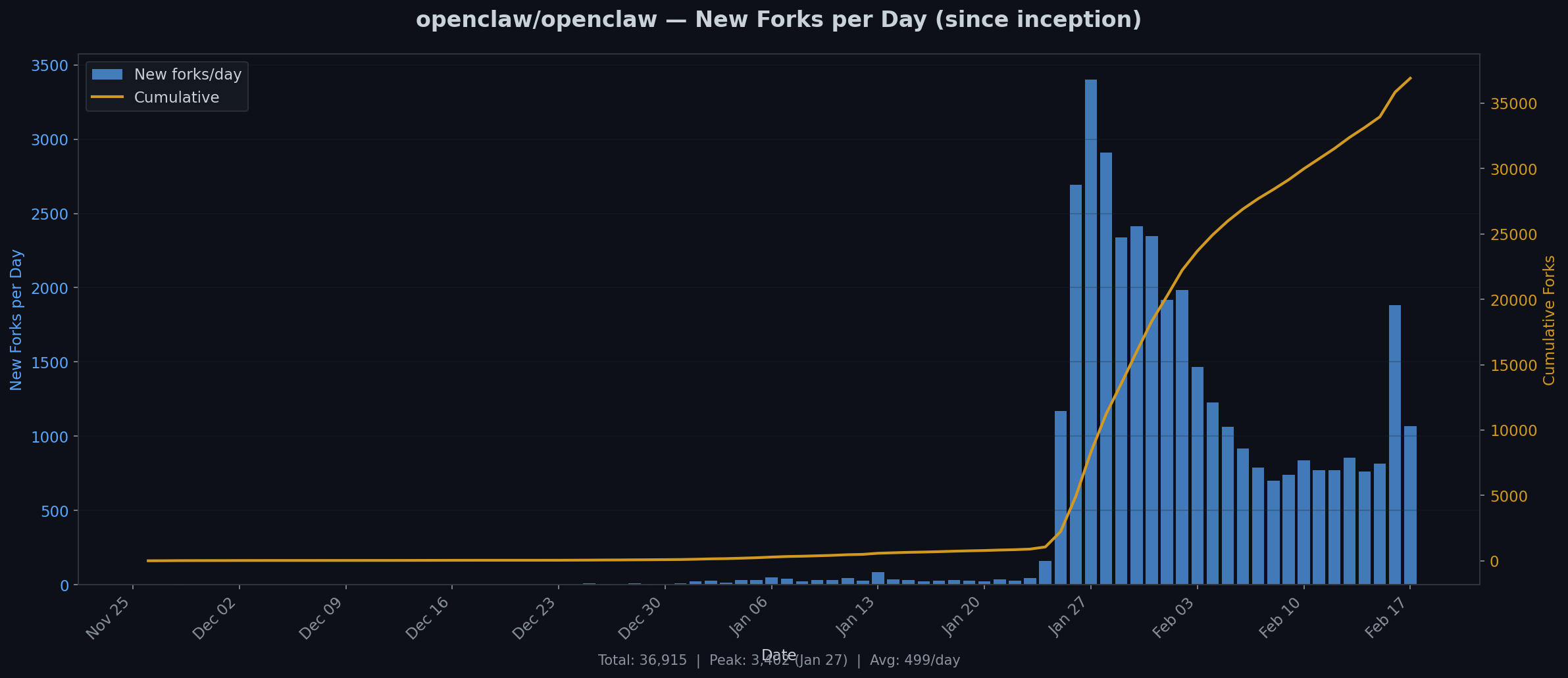
Forks per day

36,915 total forks. Peak: 3,402 on January 27. Average: 499/day.

The first fork appeared November 26, 2025. For nearly two months: nothing. A handful of early adopters per day, the kind of people who read Hacker News at 2am and clone things “to look at later.”

Then something happened around January 20.

Daily forks went from ~50 to over 1,000 in three days. By January 27, it hit 3,402 in a single day. That’s one fork every 25 seconds, sustained for 24 hours.

But here’s what the full data shows that the sample didn’t: it’s already declining. The peak was January 27. By mid-February, we’re down to about 1,000/day — still enormous, but the exponential phase lasted exactly one week. What we’re in now is the long tail. The viral moment came, the viral moment is going.

The cumulative curve tells the same story: a flat line, a vertical cliff, and then an inflection into deceleration. Classic viral adoption. The question isn’t whether it will keep growing — it will. The question is whether it levels off at 40,000 or 400,000.

Graph 2: Who actually builds anything?
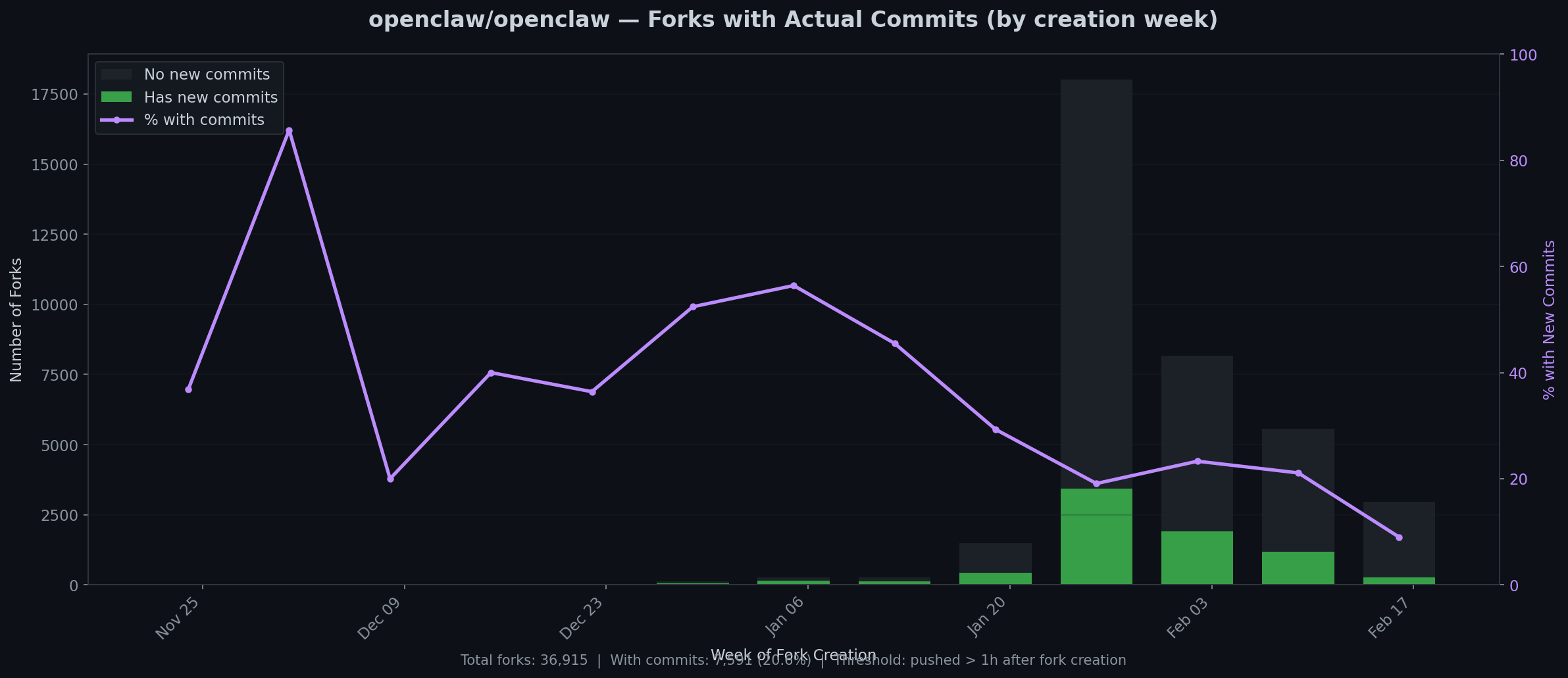
Forks with commits

7,591 of 36,915 forks (20.6%) have new commits. Threshold: code pushed more than 1 hour after forking.

This is the graph that matters.

In the early days — November, December — the commit rate was absurd. 60-90% of forks showed real work. These were people who forked because they intended to build. Small community, high signal.

Then came January’s tidal wave, and the ratio cratered. At peak volume, only about 10-20% of forks have any commits at all. The rest are what they’ve always been: GitHub bookmarks. One click, zero intention.

But zoom out from percentages and look at absolute numbers: even at 10%, that’s 300-500 people per day writing actual code on top of OpenClaw. The most recent week shows roughly 1,200 committed forks out of about 5,500 new ones. That’s a healthy project by any measure. It’s just a healthy project buried under 80% noise.

The trend line tells you something about open-source psychology: the harder a project is to use, the higher its commit rate. When OpenClaw was obscure, only competent developers found it. Now that it’s famous, everybody forks it and almost nobody builds anything. Same pattern as every framework that hits the front page of Reddit.

Graph 3: Who gives back?
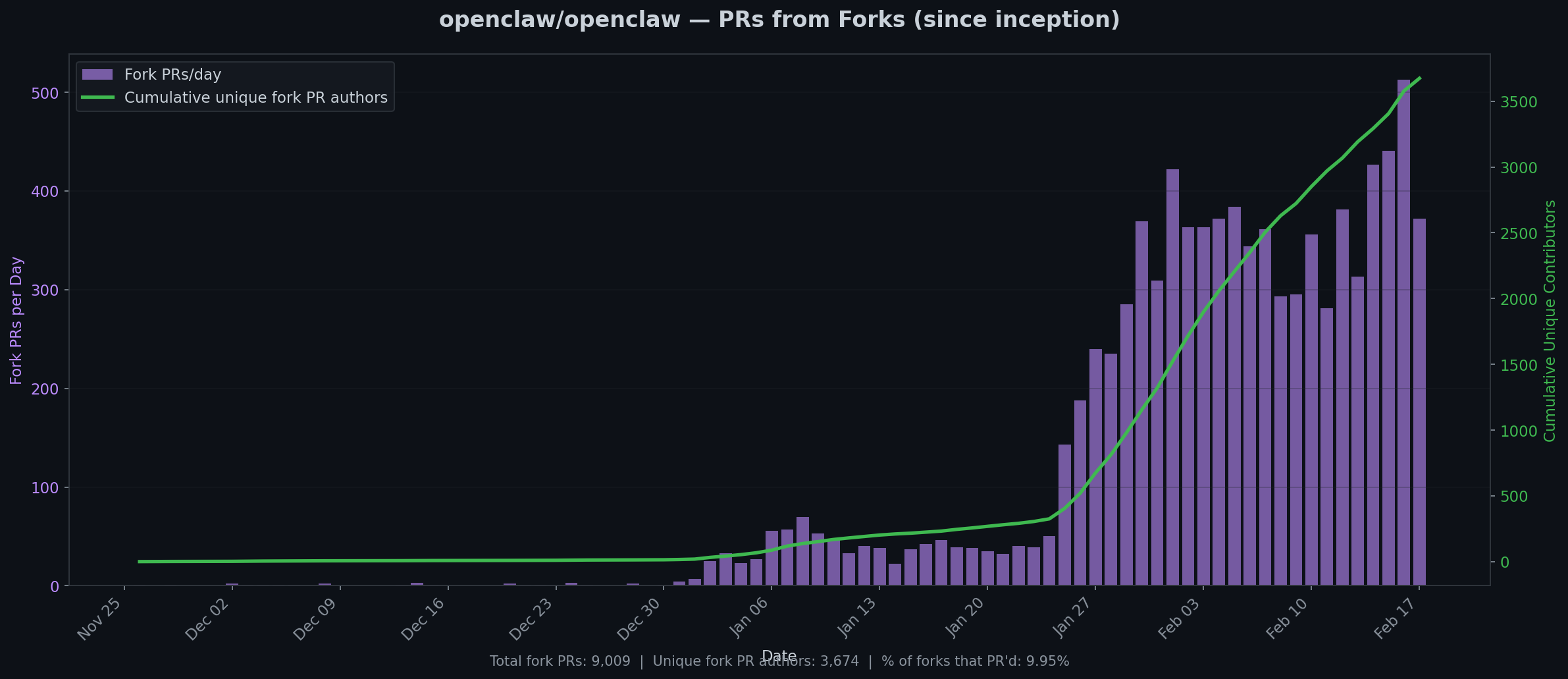
PRs from forks

9,009 fork PRs from 3,674 unique authors. 9.95% of forks ever sent a PR upstream.

One in ten. That’s actually remarkable for open source.

For context: most popular GitHub projects see PR rates of 1-2% of their fork base. React, with its 10:1 star-to-fork ratio, gets far fewer contributors relative to its fork count. OpenClaw’s 10% is unusually high — partly because the project is young and actively soliciting contributions, partly because the architecture (plugins, extensions, MCPs) makes it easy to contribute without touching core code.

The daily PR count has been climbing steadily: from single digits in December, to 50/day in mid-January, to a sustained 300-500/day now. Cumulative unique contributors crossed 3,500 and show no signs of flattening. Whatever is happening to the fork rate, the contribution rate is still accelerating.

That divergence — declining forks, accelerating PRs — is the best signal in this entire dataset. It means the project is transitioning from “thing people try” to “thing people commit to.”

What we got wrong in Part 1

Our original sample of the 100 newest forks found 19% activity. The full dataset says 20.6%. We were within a rounding error, which is either a testament to sampling theory or dumb luck. Probably both.

What the sample couldn’t show was the shape of the curve — the early period of 60-90% engagement that collapsed as volume exploded. The 20% number is real, but it’s an average across two very different populations: serious developers who forked early, and a much larger wave of tourists who forked because it was trending.

We also estimated “~2,400 forks/day” based on a snapshot. The real peak was 3,402. And by now it’s fallen to about 1,000. The snapshot caught a number that was already past its peak but hadn’t decayed enough to notice.

The numbers that matter

Forget 36,915 forks. Here’s what actually counts:

  • 7,591 forks with real commits — people building things
  • 3,674 unique PR authors — people giving back
  • ~500 PRs/day at current pace — and growing

That’s not a fork explosion. That’s a contributor ecosystem forming in real time. The other 29,324 forks are scenery.

We’ll explain shoelace eventually. Promise.


Full dataset: 36,915 forks and 9,423 PRs scraped from the GitHub REST API v3 on February 17, 2026. All forks paginated (no sampling). Commit activity measured by comparing pushed_at to created_at with a 1-hour threshold to filter initial fork sync. PR data from GitHub’s search API.
Part 1: Anatomy of a Fork Explosion

Anatomy of a Fork Explosion

OpenClaw has 34,600 forks.

Yesterday, its creator joined OpenAI.

These two facts are related in ways that are worth pulling apart.

What 34,600 forks actually looks like

A GitHub fork costs nothing — one click, two seconds. It’s a bookmark with delusions of contribution. So I pulled the data from GitHub’s API to see what’s actually going on underneath the vanity number.

GitHub’s API for listing forks returns a maximum of 400 results per request. You can sort by oldest or newest, so you get the first 400 forks ever created and the 400 most recent ones. The ~33,000 forks in between? Invisible. GitHub literally won’t show them to you. You’d need to scrape each fork individually or use their BigQuery dataset to see the full picture. I didn’t — so this analysis covers the bookends with a black hole in the middle. I’m not going to dress it up.

The growth curve

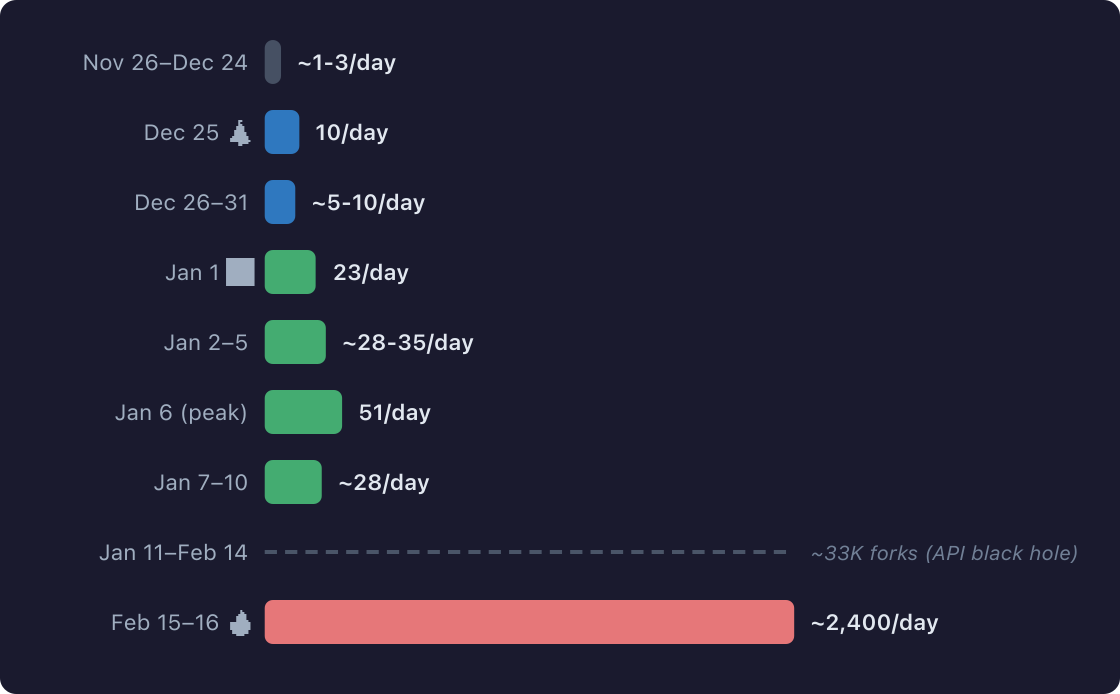
The first fork appeared November 26, 2025 — two days after the repo went public. For the next month: a trickle. One, two, three forks per day. Early adopters kicking the tires.

Then Christmas happened.

December 25: 10 forks. A 10x jump. People unwrapped laptops and had free time. The holiday week held steady at 5-10 per day.

January 1: 23 forks. Another 3x. By January 6, it peaked at 51 forks/day in the sample. New Year’s resolution energy: “this is the year I set up my own AI agent.”

And right now? ~100 forks per hour. 345 forks appeared in a 4.3-hour window. That’s a ~2,400/day pace.

The trajectory: 1/day → 10/day → 50/day → 100/hour.

Bar chart showing OpenClaw fork growth from 1-3/day in November 2025 to ~2,400/day in February 2026

Somewhere between people opening Christmas presents and Valentine’s Day, OpenClaw went from “interesting open-source tool” to “phenomenon.” Which is a convenient time for the phenomenon’s creator to get hired by the company that didn’t make it.

The 81% question

Here’s the part nobody talks about.

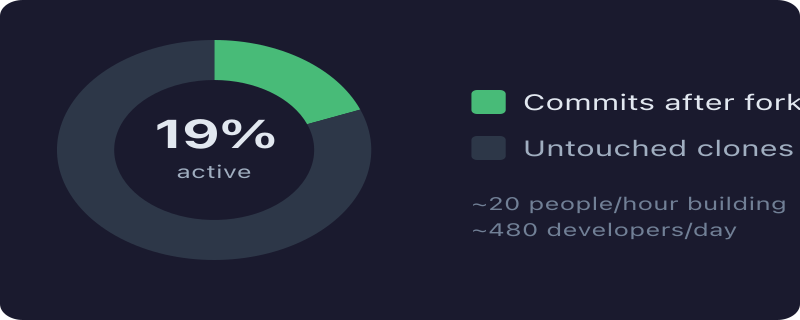
Of the 100 most recent forks — all created within the last hour of my sample — how many show any commit activity after forking?

19%.

The other 81% are untouched clones. Fork and forget. GitHub stars with extra steps.

Donut chart showing 19% of forks have commits after forking, 81% are untouched clones

But before you dismiss it: 19% of 100 forks per hour is still ~20 people per hour actually building something. That’s ~480 developers per day doing real work on top of OpenClaw. Not nothing. Especially for a project that, until yesterday, was one developer’s playground.

The ones who renamed their fork (and are apparently walking away from Omelas)

The most interesting signal isn’t volume — it’s intent. When someone renames their fork, they’re not cloning; they’re starting something new.

Highlights:

  • cl-core-mit-snapshot — someone freezing the codebase under MIT. Defensive forking. Just in case.
  • openclaw-x402-router — x402 payment protocol integration. Somebody’s building monetized agent infrastructure before the foundation even has bylaws.
  • reallyopenopenclaw — a philosophical statement in repo form. Already preemptively arguing with the future.
  • ladysclaw — rebranding energy.
  • clawguard — presumably security hardening.
  • shoelace — no explanation. Just vibes.

These are the 2% who forked with purpose. Watch them.

People aren’t just watching

OpenClaw’s stars-to-forks ratio is 5.7:1 (197K stars to 34.6K forks). For context:

  • React: ~10:1
  • Next.js: ~16:1

A low ratio means people are grabbing the code, not just bookmarking it. OpenClaw’s is unusually low. Whether that’s because the tool rewards customization, because the ecosystem hasn’t consolidated around plugins yet, or because people want to run it privately and not tell anyone — probably all three.

And now that the creator is inside OpenAI and the project is headed for a foundation? That cl-core-mit-snapshot fork starts looking less paranoid and more prescient.

The timing

Peter Steinberger announced yesterday that he’s joining OpenAI. Sam Altman said on X that OpenClaw will “live in a foundation as an open source project that OpenAI will continue to support.”

So let me get this straight: The tool was originally called ClawdBot — you can guess which model it was built for. The tool’s creator just joined OpenAI. The tool will live in a foundation that OpenAI sponsors. And 34,600 people have already forked the code, 81% of whom will never touch it again.

If you’re keeping score at home, a developer built a personal agent, originally called it ClawdBot (no points for guessing the model), made it go viral, got hired by OpenAI, and the project is now an “independent foundation” that OpenAI “supports.” This is like a Ford engineer building the best car on the market using Toyota engines, then getting hired by GM to “drive the next generation of personal vehicles.”

The claw is the law, apparently. Just not any particular company’s law.

What I couldn’t measure

Two of my three original questions remain unanswered:

  1. ✅ Fork creation over time — covered, with the API gap caveat
  2. ❌ Forks with independent commits — sampled 100, can’t do all 34,600 without days of API scraping
  3. ❌ Forks that sent PRs back to main — same problem, worse

A more rigorous analysis would use GitHub’s BigQuery dataset. This was a 30-minute investigation, not a thesis. But the 30 minutes told a story.

The real question

34,600 forks sounds massive. It is massive. But the real number is somewhere between 6,500 (19% active) and 700 (2% with intent). Still impressive, and still accelerating.

The open-source AI agent space is in its “everybody forks, nobody contributes back” phase. That’s fine — it’s how platforms grow. The interesting question isn’t how many forks exist today. It’s how many of them will still have commits six months from now, when the foundation has governance, when OpenAI’s priorities inevitably diverge from the community’s, and when the next shiny thing comes along.

History suggests: about 2%. But those 2% will be the ones that matter.


Data pulled from the GitHub REST API v3 on February 15–16, 2026. Fork listing capped at 400 per sort direction; findings are based on sampled bookends, not the full dataset.

WebMCP: A Solution In Search of the Problem It Created

Or: How Google and Microsoft Walked Into a Bar and Reinvented the Web, Worse


Google and Microsoft just co-authored a web spec together. Let that sink in.

The last time these two agreed on anything technical, IE6 was busy eating Netscape alive and “web standards” was an oxymoron. Now they’re back — holding hands under a W3C community group banner, gazing into each other’s eyes across a conference table, and delivering unto us WebMCP — a “proposed web standard” that lets websites expose “structured tools” to AI agents.

I have some thoughts.

What WebMCP Actually Is

WebMCP adds a new browser API — navigator.modelContext — that lets a web page register “tools” for AI agents to call. Each tool has a name, a description, a JSON Schema for inputs, and a handler function. Instead of AI agents scraping your DOM and squinting at screenshots like a drunk trying to read a menu, your website just… tells them what’s available.

Two flavors:

  • Declarative: You annotate HTML forms so agents can submit them directly.
  • Imperative: You write JavaScript handlers that agents invoke with structured inputs.

The Chrome team is very excited. They’ve published a blog post, opened an early preview program, and shipped it behind a flag in Chrome 146. VentureBeat wrote it up. Everyone is talking about the agentic web. The hype cycle spins.

The Problem WebMCP Solves

AI agents interact with websites by scraping the DOM, interpreting screenshots, and simulating clicks. This is fragile. It breaks when the UI changes. It’s slow and token-expensive (2,000+ tokens per screenshot vs. 20-100 tokens for a structured call). Every CSS class rename is a potential catastrophe.

This is a real problem. I’m not going to pretend it isn’t.

But here’s the thing: it’s a problem the industry created by ignoring the architecture that already solved it.

The Architecture That Already Solved It (You Didn’t Read It Either)

In the year 2000, Roy Fielding published his PhD dissertation describing the architecture of the World Wide Web. He called it REST — Representational State Transfer. You’ve heard of it. You’ve put it on your resume. You almost certainly haven’t read it.

(Don’t feel bad. Nobody has. That’s the whole problem.)

REST has one crucial, defining idea: HATEOAS — Hypermedia As The Engine Of Application State. Terrible acronym. Sounds like a sneeze. But the idea is simple and beautiful: the server’s response tells you everything you need to know about what you can do next. The links are in the response. The forms are in the response. The available actions are self-describing.

An HTML page already IS a “tool contract.” A <form> already IS a structured tool with defined inputs. A <a href> already IS a discoverable action. The entire web was designed from the ground up so that a client — any client, human or machine — could interact with a server without prior knowledge of its API, simply by following the hypermedia controls in the response.

As the htmx folks put it:

“The HTML response is entirely self-describing. A proper hypermedia client that receives this response does not know what a bank account is, what a balance is, etc. It simply knows how to render a hypermedia, HTML.”

The web already had machine-readable, self-describing, discoverable interactions. It’s called… the web. Somewhere, Roy Fielding is thinking murderous thoughts.

So What Happened?

The industry collectively decided that REST meant “JSON over HTTP with nice-looking URLs.” Which is approximately as accurate as saying democracy means “everyone gets a vote on what to have for lunch.”

Fielding himself, in a now-famous 2008 blog post, tried to set the record straight with the restraint of a man watching his house burn down:

“I am getting frustrated by the number of people calling any HTTP-based interface a REST API… That is RPC. It screams RPC. There is so much coupling on display that it should be given an X rating.”

Reader, the industry did not listen. What followed was a twenty-year sprint in the wrong direction. We abandoned hypermedia for JSON blobs. We replaced self-describing responses with Swagger docs and API versioning. We built increasingly elaborate tooling — API gateways, SDK generators, GraphQL, tRPC — to paper over the problems caused by ignoring the one constraint that made the whole thing work.

And now, in 2026, having thoroughly ignored the architecture of the web while building on the web, we’ve arrived at the logical endpoint: a new browser API so that AI agents can interact with websites in the structured way that websites were already designed to support.

Roy Fielding is no longer thinking murderous thoughts. He’s past that. He’s watching the final scene of Chinatown. “Forget it, Roy. It’s the agentic web.”

The Declarative API Is Just Forms

This is the part where I need you to really focus. From the WebMCP spec:

“Declarative API: Perform standard actions that can be defined directly in HTML forms.”

They. Reinvented. Forms.

Google and Microsoft engineers got together — presumably with catering, perhaps even a whiteboard budget — and produced a specification to make HTML forms work for AI agents. HTML forms. The things that have been telling machines “here is an action, here are the inputs, here is where to send it” since 1993.

The <form> element is literally a structured tool declaration with a name (action), a method (GET/POST), and typed inputs (<input type="text" name="destination" required>). It has been machine-readable for thirty-three years. It is older than some of the engineers who wrote this spec.

But sure. Let’s add an attribute. Innovation.

The Imperative API Is Just RPC (Again)

The other half of WebMCP is the “imperative API,” where you register JavaScript handler functions that agents call with JSON inputs.

This is RPC. Specifically, it’s RPC mediated by the browser, authenticated by the user’s session, and invoked by an AI agent instead of a human. Which is a perfectly fine idea! RPC is useful. It has always been useful. SOAP did this in 1999. CORBA did it before that. Every SPA with a JavaScript API layer does it today.

The new part is navigator.modelContext.registerTool() instead of window.myApp.doThing(). The innovation is… a namespace. Alert the press.

The Security Section Reads Like a Horror Novel

WebMCP’s own specification describes something it calls the “lethal trifecta”: an agent reads your email (private data), encounters a phishing message (untrusted content), and calls a tool to forward that data somewhere (external communication). Each step is legitimate individually. Together, they’re an exfiltration chain.

The spec’s own analysis of this scenario? “Mitigations exist. They reduce risk. They don’t eliminate it. Nobody has a complete answer here yet.”

Nobody has a complete answer yet. They shipped it behind a flag in Chrome 146 anyway. This is the “we’ll add seat belts in v2” school of automotive engineering.

The destructiveHint annotation — the mechanism for flagging “this tool can delete your data” — is marked as advisory, not enforced. The spec literally says the browser or agent can ignore it. It’s a polite suggestion. A Post-it note on the nuclear button that says “maybe don’t?”

And there’s no tool discovery without visiting the page. Agents can’t know what tools Gmail offers without opening Gmail first. The spec proposes future work on a .well-known/webmcp manifest. You mean like robots.txt? Or /.well-known/openid-configuration? Or the dozens of other discovery mechanisms the web already has? Groundbreaking.

The Real Game

Now let’s talk about what this actually is, under the hood.

Google and Microsoft don’t control the API layer. They can’t dictate how backends expose services. But they do control the browser. WebMCP puts the browser — Chrome and Edge, i.e., Chromium with two different logos — at the center of every agent-to-website interaction.

Every AI agent that wants to use WebMCP must go through the browser. The browser mediates authentication, permissions, consent. The browser becomes the gatekeeper. If you control the browser, you control the chokepoint.

This is the same play Google made with AMP: take a real problem (slow mobile pages), create a solution that requires routing through Google’s infrastructure, W3C-wash it, and call it open. WebMCP takes a real problem (agents can’t interact with websites reliably) and creates a solution that routes through Chromium.

MCP (Anthropic’s protocol) connects agents to backend services directly — no browser needed. WebMCP says: no no, come through our browser. That’s not interoperability. That’s a tollbooth with a standards document.

What Should Have Happened

If we actually wanted AI agents to interact with websites reliably, we could:

  1. Build better hypermedia clients. Teach AI agents to understand HTML — forms, links, semantic structure. The web is already machine-readable. We just need clients that aren’t illiterate.
  2. Use existing standards. Schema.org, Microdata, RDFa, JSON-LD — mature standards for machine-readable web content. Google built an entire search empire on them. They work today.
  3. Write APIs. If you want structured machine-to-machine interaction, build an API. REST (actual REST), GraphQL, gRPC — pick your poison. No new browser API required.
  4. Use MCP where appropriate. For backend service integration, MCP does the job without inserting a browser into the loop.

None of these require a new browser API. None of them route through Chromium. None of them require Google and Microsoft to co-author anything.

The Cycle

This is the software industry’s most reliable pattern:

  1. A good architecture is proposed (REST, 2000)
  2. The industry ignores the hard parts (HATEOAS, hypermedia)
  3. The easy parts get cargo-culted (“REST means JSON + HTTP verbs”)
  4. Problems emerge from ignoring the architecture
  5. A new spec is proposed to solve those problems
  6. The new spec doesn’t mention the old architecture
  7. Go to 1

WebMCP is step 5. The Chrome blog post doesn’t mention REST. Doesn’t mention HATEOAS. Doesn’t mention hypermedia. It talks about “the agentic web” as if machine-readable web interactions are a bold new idea that needed inventing in 2026.

Roy Fielding wrote the answer to this problem in his dissertation. In 2000. It’s free to read. It’s shorter than the WebMCP spec. And unlike WebMCP, it doesn’t require Chrome 146.


But sure. Let’s add navigator.modelContext. What’s one more API between friends?